Posted on Leave a comment

Amber Purple: Cooling, Annealing, and What Happens After the Torch

blog post 3 featured image

Amber Purple: Cooling, Annealing, and What Happens After the Torch

The Work Doesn’t End When the Torch Turns Off

The work does not end when the torch turns off. With Amber Purple, the color you finish with at the bench is only part of the story. This is a striking glass, and that means the final result depends on heat history, flame atmosphere, surface condition, and what happens in the kiln afterward. Cooling and annealing are not just there to keep the piece from cracking. They are part of how the color settles, deepens, or gets lost. 

close up of down stem

Cooling Holds the Colour You Built

It helps to separate two different jobs that often get blended together. One job is color development. The other is structural annealing. Northstar’s general borosilicate chart puts the standard annealing temperature at 1050°F and the strain point at 960°F, with anneal time scaling by thickness. That means a proper post-torch cycle is not just one hold and done. The piece still needs time to stabilize after any strike work is finished. In thicker or more complex work, the first soak below anneal matters even more because that is where the structure starts to come into balance before the rest of the cool-down continues. 

Surface Condition Before the Kiln

Before Amber Purple ever goes into the kiln for color development, the surface has to be clean. Northstar is very clear about this. The initial haze is reduced silver metal that leaves the body of the glass and deposits on the surface. If that layer is left in place, it thickens, turns matte gray, and masks the real color underneath. Their published procedure is to turn the work slowly in a strong sharp oxidizing flame and heat the surface aggressively enough that it almost boils, because that initial clean-up is the step everything else depends on. The kiln will not rescue a dirty surface. It will only develop what you gave it. 

Flame Striking and Kiln Striking Are Not the Same Thing

Once the haze is removed, there are two different ways to push the color. If you want a gradient or a more selective look, Northstar’s flame-strike method is simple and very controlled: let the piece cool for about twenty seconds, wait until the glow is gone, then bring it back in a soft neutral flame so the surface barely glows. If you want it darker, repeat in short increments. That approach lines up with a broader striking pattern seen on the Glass Alchemy side too: reset the color hot, let it rest, then reintroduce heat in very small doses because short exposures can make large visible differences. Flame striking is best when you want control over where the color develops. Kiln striking is better when you want the color to develop more evenly through the piece. 

The Kiln Range That Actually Matters

amber purple mouthpiece

For Amber Purple itself, Northstar’s published kiln-strike window is more specific than the ranges people often repeat from shop talk. Their family page says to place haze-free, unstruck Amber Purple in the kiln and hold it at 1125°F to 1150°F for about sixty minutes, or until the desired intensity is reached. That hold is for color development, not for the final structural anneal. After that stage, the work still belongs on a proper borosilicate anneal path near 1050°F. Other makers’ amber-to-purple and silver-striking pages do reinforce the idea that extra kiln time around 1100°F can deepen certain colors, but those are adjacent formulations and should be treated as supporting evidence, not replacements for Northstar’s direct Amber Purple schedule. 

Thin Work Needs More Restraint

This is the point where patience matters. Northstar explicitly warns that thinner work may slump at the published Amber Purple strike temperatures. Their older BoroNews issue also warns that even the initial haze-removal phase has to be done quickly enough to avoid boiling and slumping. In practice, that means the hotter kiln-strike window is powerful, but it is not something to apply casually across every form. Thin blown work, delicate details, and pieces that are already close to moving should be approached more carefully than heavier sculpture or thicker sections. 

Common Problems After the Torch

Most problems in this stage trace back to one of four things. The first is poor oxidation when the goal was purple. Northstar’s current pages consistently point toward oxidizing or at least neutral-to-slightly oxidizing conditions for the strongest purples, while warning that reduction pushes the color toward milky amber, opacity, or other off-path results. The second is leftover haze. If the silver stays on the surface, the color goes gray and loses life. The third is confusing strike temperature with anneal temperature and skipping the structural soak after the color hold. The fourth is assuming the hot look is the final look. Across the other two source sets, the same pattern shows up again and again: some silver-striking colors look clearer while working, some need to be fully worked before purple will show, and some darken only after deliberate kiln time. 

Carrying Control Through the Whole Cycle

Amber purple beaker

The real lesson here is that Amber Purple rewards continuity of control. You do not finish the color at the torch and then hand the rest of the job over to the kiln. You carry the same discipline all the way through: clean the surface completely, decide whether you want a flame gradient or a kiln-developed field of color, separate the strike hold from the structural anneal, and watch the form while the color is being pushed. That is how stronger saturation, cleaner purples, and more consistent results actually happen. 

What Comes Next

Once the post-torch phase is understood, the next step is using that control on purpose. The next post can move into layering, encasement, and design choices, because that is where the color is not just preserved but directed. By that point, the question is no longer whether Amber Purple will strike. It is how intentionally you want it to do it. 

website logo

Posted on Leave a comment

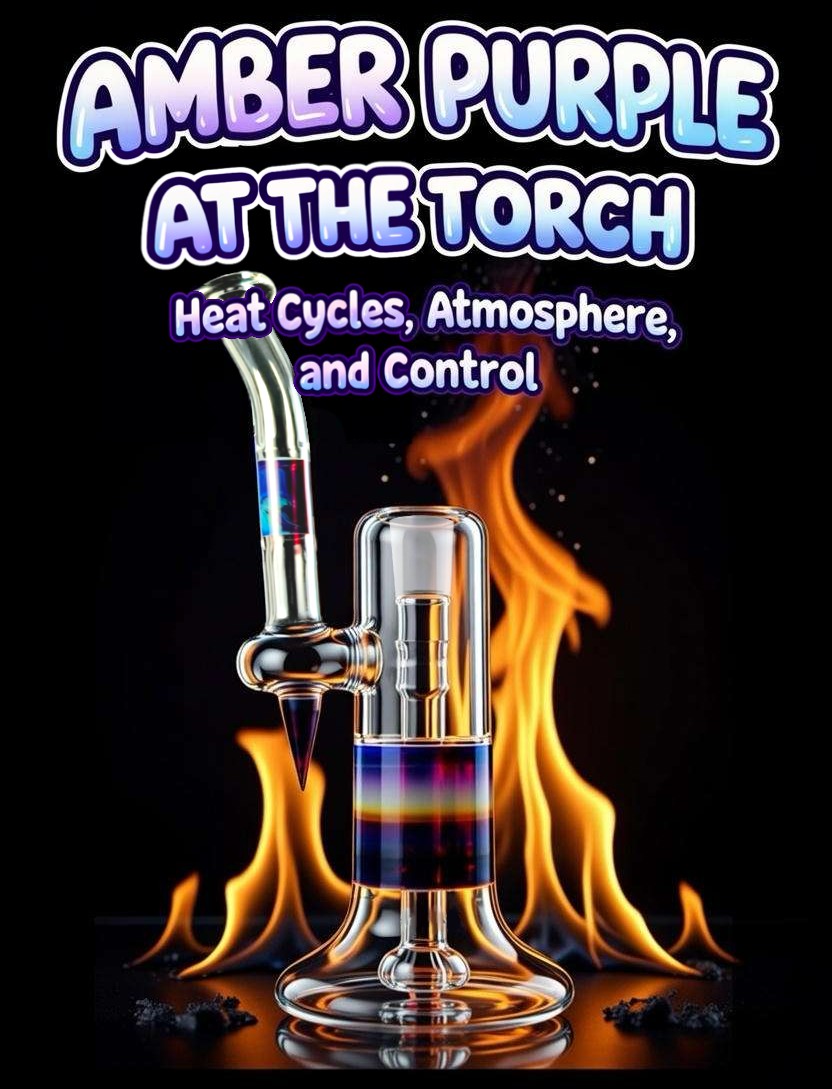
Amber Purple at the Torch: Heat Cycles, Atmosphere, and Control

In the first post of this series, we talked about what Amber Purple is, where it comes from, and why it behaves differently than most colours. At the end of that post, we said the next step would be understanding how heat, flame atmosphere, and timing shape the final look of the glass. That is exactly what this post is about.

Amber Purple is not a colour you force into place. It is a colour that develops slowly through repeated heat cycles and careful control at the torch. When it works well, it feels almost effortless. When it goes wrong, it usually comes from improper flame settings and rotational speed.

Heat Cycles Are the Foundation

close up of amber purple mouth piece

Amber Purple is often called a striking colour, but that word alone does not fully explain what is happening. The colour develops through a series of heat and cool cycles, not a single moment at the torch. Early on, the glass may look pale, amber, or even close to clear. This is normal and not a sign that something has gone wrong.

The real colour begins to appear after the glass is heated evenly, allowed to cool until the glow fades, and then gently reheated. Each time this happens, the silver inside the glass shifts and reorganizes. These changes build on each other. Long, aggressive heating, tends to erase progress. While short, controlled reheating, allows the colour to deepen and separate.

Instead of chasing colour, it helps to think in terms of rhythm. Heat the glass evenly, let it rest, then bring it back slowly. Amber Purple responds best when it is given time to do the work itself.

Flame Atmosphere Shapes the Outcome

Flame chemistry plays a major role in how Amber Purple finishes, even when the heat cycles are done well. In a neutral to slightly oxidizing flame, the glass tends to stay clear and open. This environment supports cooler purples, lavenders, blues and softer transitions between colours.

A reducing flame changes the direction of the colour. Brief exposure can bring out warmer ambers, gold tones, and oil-like surface effects. Too much reduction, however, often leads to muddy browns or dull greys that are difficult to recover.

For most of the process, Amber Purple benefits from staying in neutral to slightly oxidizing flame environment. A reducing flame works best when it is applied lightly and late, almost as a final adjustment rather than a constant condition.

Timing Matters More Than Power

Many problems with Amber Purple come down to timing and flame settings. Reheating the glass too soon after the glow disappears can stall colour development. Letting it cool too far can make the next heat cycle uneven. Trying to force the colour by adding more heat usually makes things worse.

amber purple bubbler

One factor that often gets overlooked is rotational speed. Once the flame is set correctly, slowing down your rotation can make a noticeable difference. A slower turn allows the heat of the flame to penetrate deeper and faster into the glass instead of just skimming the surface. This helps burn off the initial, dull layer of silver and gives the colour room to develop beneath it.

When rotation is too fast, the surface stays hot while the interior never quite catches up. Slowing down creates an even heat profile and reduces the urge to overheat the outside and strengthen the initial layer of silver.

Learning when to pause, slow down, and let heat soak in is just as important as knowing when to reintroduce the flame.

Where You Place the Color Matters

Amber Purple behaves differently depending on where it sits in a piece. Thicker sections hold heat longer and tend to strike deeper and richer. Thinner areas cycle faster and are easier to overwork. When Amber Purple is placed next to clear, the surrounding mass can help stabilize heat and improve clarity.

Design choices matter here as much as flame control. Forms with clean lines and even wall thickness heat more evenly, which gives Amber Purple the time and stability it needs to develop fully. When the design works with the natural transparency of the colour instead of trying to overpower it, the result is clearer, deeper, and far more consistent.

Common Problems and What Causes Them

crucible pulled amber purple tubing in different stages of heat cycles

When Amber Purple turns muddy or brown, it is usually the result of too much reduction. A very common issue is a grey or dull finish caused by not fully burning off the initial silver haze. This happens when the surface stays hot but the heat never penetrates deeply enough to clear that first layer of silver.

Greying from this haze is often tied to moving too fast at the torch. High rotational speed can keep the surface active while the interior remains underheated. Slowing rotation and allowing the heat to soak in helps clear the haze before additional heat cycles are introduced.

Washed-out greys can also come from repeated reheats without enough cooling time in between. Patchy or uneven colour is commonly tied to uneven wall thickness or heating only part of a section instead of the whole area. Understanding these outcomes makes it easier to avoid or utilize them.

Consistency Comes From Process

Working Amber Purple successfully is less about tricks and more about repeatable habits. Paying attention to flame atmosphere, heat timing, and cooling intervals leads to more consistent results over time. Treating the colour as a system rather than a mystery helps remove frustration from the process. Small notes about what worked and what did not can go a long way toward dialing in control.

What Comes Next

In the next post, the focus will move away from the torch and into cooling and annealing. We will look at how kiln schedules affect Amber Purple, why some pieces look better the next day, and how post-flame decisions can either preserve or flatten the colour you worked to develop. What happens after the torch matters just as much as what happens in it.

This blog series includes insights informed by technical discussions and historical BoroNews newsletters published by Northstar Glassworks, a leading borosilicate glass manufacturer and pioneer of striking and transparent borosilicate colours used by artists worldwide. Northstar’s colour palette and working characteristics have played a foundational role in how artists understand flame reaction and colour development in borosilicate. For more archived newsletters and colour information, visit https://www.northstarglass.com.

All examples shown in this series feature Amber Purple borosilicate worked by Green Belt Glass.

Lorem Ipsum has been the industry’s standard dummy text ever since the 1500s.