Posted on Leave a comment

Glass Alchemy Pastel Serum: Soft Colour, Subtle Shift, Careful Heat

In this fifth post in our colour series and the second dedicated colour discussion we are looking at Glass Alchemy Pastel Serum.

Pastel Serum is the pastel version of Glass Alchemy’s Serum. It keeps the lighting-reactive CFL character of the Serum family, but places it into a softer pastel base. That gives it a very different working personality than a clearer transparent CFL colour. It can be subtle, creamy, and elegant, but it also asks for a lighter touch in the flame.

This is not a colour that wants to be blasted, overworked, or pushed thin and hot. Pastel Serum rewards balance.


What Kind of Colour Is Pastel Serum?

Pastel Serum sits in two useful categories at once.

First, it belongs to the Serum family, meaning it has a CFL colour-shift quality. Depending on the lighting, it can move between softer peach and pink pastel tones.

Second, it belongs to Glass Alchemy’s pastel line, which means it has more body and softness than a standard transparent colour, but it is not fully opaque. That semi-transparent pastel quality is what makes it useful for sculptural detail, soft overlays, accents, and blown forms.

The important thing to understand is that Pastel Serum is not a traditional strike colour. You are not trying to force a silver-style strike or chase a specific kiln activation. Its main effect comes from the way the colour reacts to different light sources.


Best Flame for Pastel Serum

Pastel Serum should be worked in a neutral flame.

That means avoiding both heavy reduction and aggressive oxidation. A balanced flame gives the colour the best chance to stay clean while preserving the pastel base.

The biggest mistake with Pastel Serum is overheating it, especially in thin applications. When the colour is worked too thin and too hot, the pastel base can cook out and the colour can become more transparent than intended.

For best results:

  • Work in a neutral flame.
  • Avoid working too close to the torch face.
  • Do not repeatedly blast thin details.
  • Keep enough material in the application for the pastel body to survive.

Where Pastel Serum Works Best

Pastel Serum is especially strong in blowout-style work.

Blowouts allow the colour to spread into a smooth, soft field without forcing it into an ultra-thin, overworked application. This helps preserve the pastel quality while still showing off the CFL shift.

Good uses for Pastel Serum include:

  • Blowouts
  • Soft pastel overlays
  • Sculptural accents
  • Marbles
  • Hollow forms

Pastel Serum is less ideal for very thin stringer work or tiny details that require repeated reheating. It can still be used that way, but it needs more care.


Layering and Encasement

Pastel Serum can be layered or encased, but the same rule applies: do not overheat it.

When layering Pastel Serum under clear, make sure the colour has enough body before you encase it. If the layer is too thin, the heat from the encasement and later shaping can reduce the pastel effect and make the colour look washed out.

For stronger results, use a slightly more substantial layer of Pastel Serum before adding clear. This gives the pastel base more chance to remain visible after the piece is worked.

Encasement can add depth, but it should not be used as an excuse to overwork the colour. Keep the heat controlled, move efficiently, and avoid unnecessary reheating.


Understanding the CFL Shift

Pastel Serum is a lighting-reactive colour. That means it can look different depending on where it is viewed.

A piece will look yellow under natural light and pink under fluorescent or CFL-style lighting. This is part of the colour’s identity.

This is one of the most important mental shifts when working with CFL colours: the final look is not only created in the flame. It is also revealed by the environment.


Kiln Notes

Glass Alchemy does not publish a Pastel Serum-specific strike temperature or kiln activation schedule.

That means Pastel Serum should not be treated like a kiln-strike colour. Use your normal calibrated borosilicate annealing schedule and focus on proper heat control during the actual working process.

Your kiln still matters, of course. Kilns vary by model, element placement, thermocouple position, and calibration. For repeatable colour results, especially with more sensitive colours, it is worth learning how your own kiln behaves.

But with Pastel Serum, the main colour control happens in the flame and in the design choices, not through a special kiln cycle.


Common Mistakes with Pastel Serum

1. Working It Too Thin

Thin applications are the danger zone. If Pastel Serum gets too hot while thin, it can lose its pastel body and become more transparent.

Fix: Use slightly more material and avoid excessive reheating.

2. Overheating the Colour

Pastel Serum does not need aggressive heat to “activate.” Too much heat can damage the soft pastel quality.

Fix: Work in a neutral flame and use controlled, efficient heat.

3. Reworking Encased Sections Too Much

Repeated high heat after encasement can weaken the pastel appearance underneath.

Fix: Build enough colour mass before encasing and reduce unnecessary rework.

4. Using It Where a Crisp Opaque Is Needed

Pastel Serum is semi-transparent and subtle. It is not the right choice when you need a hard, dense, fully opaque colour.

Fix: Use it where softness, glow, and light response are part of the design.


Design Takeaway

Pastel Serum is a subtle, elegant colour when treated properly. It works best when you give it enough mass, keep the flame neutral, and design around its soft CFL shift.

Think of it less as a colour to force and more as a colour to preserve.

Use it in blown forms, soft overlays, and sculptural accents where its pastel body can remain visible. Avoid pushing it too thin, too hot, or too many times through the flame.

When handled with restraint, Glass Alchemy Pastel Serum can bring a soft, lighting-reactive quality that sits somewhere between transparent colour, pastel body, and atmospheric shift.

website logo

Posted on Leave a comment

Amber Purple Layering, Encasement, and Design Choices

If the previous posts in this series focused on heat history and what happens after the torch, this is the stage where you start deciding what kind of object Amber Purple is actually going to become.

Layering and encasement are not just decorative choices with this color family. They change how light enters the piece, how the strike reads, how much depth the work carries, and how forgiving the final finish will be.

The simplest way to think about it is this:

Use the backing to control brightness.
Use the Amber Purple layer to control the strike character.
Use the cap to control depth and presentation.

Bright reflective backings, especially Star White, can push Amber Purple toward a stronger, cleaner glow. Warm interlayers such as Yellow or Orange can pull out fire, amber, and red tones. Transparent caps such as clear, Violet, or Lavender can add depth, magnification, and a cooler finished read.

The important rule is that Amber Purple needs to be clean before you bury it. The kiln will develop what you built at the torch. It will not rescue haze, reduction, or contamination trapped under the surface.

When you want gradients, strike through the flame. When you want a more even read through the whole form, kiln striking becomes the better tool.


Working Assumptions

This post assumes standard 33 COE borosilicate practice, experienced bench skills, and no single fixed torch or kiln model.

That matters because a “neutral” or “oxidizing” flame does not look exactly the same on every torch. Kilns also vary in recovery, accuracy, and heat distribution.

For Amber Purple, the safest working baseline is neutral-to-oxidizing. If the goal is a clean purple strike, do not let the flame drift reducing.

This post also assumes that exact piece thickness is not specified. Annealing and striking decisions should always be adjusted for the actual object. Closed forms, thick sections, complex color stacks, and deeply encased metallic colors all deserve extra caution.

Compatible COE is only the first filter. Similar annealing behavior still matters, especially when multiple colors and metallic chemistries are stacked together.


Why Layering and Encasement Matter

Encasing is worth doing when it solves a visual or technical problem. It should not be treated as an automatic upgrade.

A clear or transparent cap can add depth, protect the layer below it, and create new color impressions by acting as an optical filter. In practical studio terms, encasement lets you decide whether Amber Purple will read as:

  • a surface color,
  • a buried color,
  • or part of a more complex optical stack.

Strong borosilicate design often comes down to restraint. The goal is not always more color. Often, the goal is better control over how the color is seen.

Northstar’s own Amber Purple examples point toward a consistent design logic: use a reflective or warm base to shape the light first, then let Amber Purple do the actual striking.

A white backing is especially important. Star White can act like a reflective base that makes Amber Purple appear brighter and more luminous. It also helps suppress the brown transmitted tint that Amber Purple can show when light passes straight through the piece.

That is one of the best reasons to use layering deliberately. Backings do not just make colors brighter. They change which part of the color is allowed to dominate.


Building the Stack

Materials and Compatibility

Stay within 33 COE borosilicate, but do not confuse “same COE” with “same behavior.”

A color may fit the COE range and still behave differently during annealing, striking, or deep encasement. This becomes especially important with metallic and saturated colors.

For Amber Purple stacks, the safest route is to keep the major layers within one manufacturer family unless you have already tested the combination.

If you mix color families, treat saturated or chrome-bearing colors more carefully than the label might suggest. Some pairings may benefit from a thin clear separator. Others may appear fine hot but show checking later.

The practical rule is simple:

Test small before building big.

A good-looking hot connection is not always a stable cold connection.

If you are working with lined tubing instead of applying all layers from rod, preheating becomes part of compatibility practice. Layered tubing already contains uneven thermal mass, so slow kiln preheating can help reduce thermal shock.


Layer Order

The cleanest way to think about an Amber Purple stack is as three separate jobs:

  1. The backing or interlayer
  2. The Amber Purple strike layer
  3. The clear or transparent cap

In most cases:

  • the backing controls brightness,
  • the Amber Purple controls the hue shift,
  • and the cap controls depth.

That structure usually gives more reliable results than trying to make every layer do everything at once.


For a Bright Purple Read

Start with a reflective backing, usually Star White. Apply an even Amber Purple layer over it. Then decide whether the piece needs a clear cap or a cooler transparent cap.

A basic bright-purple stack might look like this:

LayerPurpose
Star White backingReflects light and increases brightness
Amber Purple layerProvides the strike color
Clear, Violet, or Lavender capAdds depth, polish, and optical control

Violet or Lavender can be useful when you want the finished color to read cooler and more intentionally purple. They are especially useful as quiet caps because they do not add the same kind of flame-management problem as another reactive silver color.


For Warmth, Fire, and Honey Tones

If the goal is fire instead of a straight purple read, use a warm interlayer.

Yellow or Orange over Star White can pull Amber Purple toward deeper amber, red, honey, or fiery tones.

A warm stack might look like this:

LayerPurpose
Star White backingReflects and brightens
Yellow or Orange interlayerAdds warmth and internal fire
Amber Purple layerProvides the reactive strike
Optional clear capAdds depth and protection

This is a strong approach when you want the piece to glow from the inside rather than simply read as purple on the surface.


For Softer or Pastel Contrast

For softer contrast, consider opaque base colors such as Bubblegum or Periwinkle.

These are not usually the first choices for maximum saturation, but they can be excellent when you want a more atmospheric, illustrative, or pastel palette.

A softer stack might look like this:

LayerPurpose
Bubblegum or Periwinkle backingCreates a softer color foundation
Amber Purple layerAdds strike variation
Clear or transparent capAdds depth and polish

This approach is useful when the design needs mood, subtlety, or contrast rather than maximum intensity.


Thickness Guidance

Thickness matters, but the most useful guidance is relative rather than numeric.

A heavy backing can work well because its job is to reflect or filter light. The Amber Purple layer itself usually reads best as a controlled, even skin rather than a bulky mass, unless the goal is thick sculptural color.

The cap should be thick enough to unify and lens the layer, but not so heavy that it softens the form or magnifies every flaw beyond what the design can support.

Different members of the Amber Purple family also behave differently. Some are better suited to thicker blown or sculptural work, while others can be stretched further in thinner applications.

So the real question is not only:

How thick should the Amber Purple layer be?

It is also:

Which member of the Amber Purple family is best suited to this job?

If the form is going thin, it may make more sense to choose a darker or more concentrated family member than to force a lighter one to do work it is not optimized for.


A Simple Design Decision Guide

Use this as a starting point when choosing an Amber Purple stack.

If you want the brightest purple read

Use:

  • Star White backing
  • even Amber Purple layer
  • clear, Violet, or Lavender cap

Best for: clean purple, bright optical depth, high contrast.

If you want warmth and fire

Use:

  • Star White backing
  • Yellow or Orange interlayer
  • Amber Purple layer
  • optional clear cap

Best for: honey tones, amber-red notes, internal glow.

If you want a softer or more pastel effect

Use:

  • Bubblegum or Periwinkle backing
  • Amber Purple layer
  • clear or transparent cap

Best for: softer palettes, atmospheric work, illustrative contrast.

If you want a gradient

Use:

  • controlled flame striking
  • short oxidizing reheats
  • careful observation through the cap

Best for: directional color, transitions, painterly effects.

If you want uniform color

Use:

  • clean, haze-free Amber Purple
  • kiln strike after construction
  • appropriate annealing for the full stack

Best for: even development, consistency, production-style control.


Flame, Kiln, and Heat History

Before the Cap Goes On

The most important technical rule is simple:

Do not bury dirty Amber Purple.

The initial metallic haze needs to be removed before the piece is worked further or encased. If you trap that gray layer under clear or under a transparent tint, you do not get mysterious depth. You get a cleaner view of the mistake.

The surface should be cleaned up in a strong oxidizing flame before the cap goes on. Keep the work moving, heat evenly, and avoid reduction.

The more even the heat penetration before encasement, the cleaner the final result tends to be. Deep, even heat profiles help build internal color. Shallow or inconsistent reheats tend to leave haze, veil, or surface-biased effects.

Encased silver colors punish impatience more harshly than exposed ones.


What Changes Once Amber Purple Is Encased

Once Amber Purple is buried, the flame and kiln stop behaving like interchangeable tools.

Flame striking through a cap is local, fast, and expressive. It is useful when you want gradients, transitions, or selective development.

Kiln striking is slower and more even. It is usually the better choice when the goal is uniform color throughout the work.

The cap gives you optical depth, but it also changes heat response. It can make localized reheat possible, while also making even flame penetration harder to achieve.

Think of it this way:

ToolBest Use
Flame strikeGradients, selective color, expressive transitions
Kiln strikeUniform color, even development, repeatability

Both are useful. They are not the same tool.


A Practical Strike Sequence for Encased Amber Purple

A reliable working sequence looks like this:

  1. Build and smooth the backing first.
  2. Heat opaque backings slowly enough to avoid pits, bubbles, or boiling.
  3. Apply the Amber Purple layer evenly.
  4. Burn off the initial haze before encasing.
  5. Add the clear, Violet, or Lavender cap only after the surface is clean.
  6. For gradients, use short oxidizing reheats through the cap.
  7. For uniform color, move the piece to the kiln while the buried Amber Purple is clean and not fully overworked.

The goal is to give the kiln clean material to develop, not contaminated material to fix.


Kiln Schedule for Encased Amber Purple

The schedule below is a practical starting point for encased Amber Purple work in 33 COE borosilicate.

It is not a universal program. Closed forms, thicker work, metallic color stacks, and kilns with uneven recovery may need longer soak times, slower drops, or both.

StageTemperatureHoldPurpose
Optional kiln strike1125–1150°FAbout 60 minutesDevelop a more uniform strike in clean, haze-free Amber Purple
Anneal soak1050°F1 hour per 0.25 inches of thicknessRelieve working stress in standard 33 COE borosilicate
First controlled drop925°F50% of anneal time for pieces 0.25 inches or less; 100% for pieces over 0.25 inchesSlow equalization below the strain point
Second drop850°F25% of anneal timeContinue controlled cooling
Third drop700°F25% of anneal timeStabilize thicker or more complex forms
Fourth drop500°F25% of anneal timeControlled exit before room-temperature cooling

Metallic color stacks may sometimes benefit from slightly higher annealing temperatures or longer soaks. The more complex the stack, the less you should treat it like plain clear.


Common Failure Modes

Gray or Muddy Color Under the Cap

This is usually a trapped-haze problem, a reduction problem, or both.

If the gray layer is already buried, reheating may move the color around, but it usually will not become the vivid clean strike you wanted.

Prevention matters more than rescue.

Fix the surface before the cap goes on.


Weak Purple and Too Much Amber

If the finished color feels too warm, the problem is usually stack logic rather than one single bad moment.

Possible causes include:

  • the backing is too warm,
  • the Amber Purple layer is too thick,
  • the work was not developed evenly after encasement,
  • or the cap/interlayer is pushing the color away from purple.

Yellow and Orange deliberately push Amber Purple toward warmer amber-red reads. Violet, Lavender, and Star White are usually better choices when the goal is a stronger purple impression.


Checks, Cracks, or Late Failures

When a piece looks fine hot and checks later, think beyond COE.

Late failure can come from:

  • mixed color families,
  • incompatible annealing behavior,
  • saturated or reactive colors,
  • overly aggressive cooling,
  • closed forms,
  • or thick encasement.

Test new combinations. Extend soaks when the stack is complex. Avoid aggressive temperature drops through thick or closed encased work.


Boil, Pits, or Rough Backings

This usually starts before Amber Purple ever enters the picture.

Opaque backings such as Star White and Bubblegum need slow, controlled heating. If the backing is rough, pitted, or boiled, the Amber Purple layer over it rarely reads clean.

A clear cap will not hide that problem. It will magnify it.


Distorted Pattern After Encasing

If the cap blurs, stretches, or distorts the design too much, the issue is often mechanical rather than chromatic.

Tube encasement can be a better option when the pattern matters as much as the color. It allows you to preserve the design while still adding a lens.

When the drawing is important, protect the pattern before chasing optical depth.


Design, Finishing, and Cleaning

Transparency, Depth, and Contrast

Clear is the most honest cap. It gives maximum depth, maximum magnification, and the least added color bias.

Violet or Lavender can be better when you want the finished color to read cooler and more intentionally purple.

Star White is the strongest move when you want reflective brightness.

Yellow or Orange is the move when you want internal fire.

Each layer should have a job.

One of the easiest advanced design mistakes is trying to get too many effects from one piece. Clear can lens. Violet can cool. Star White can brighten. Yellow can warm. Amber Purple is already reactive and complex.

If all of those moves are pushed equally, the work can become visually busy and technically fragile at the same time.

The strongest encased Amber Purple pieces usually pick one primary job for each layer and let the rest of the stack stay quiet.


Finishing Decisions

Finishing encased Amber Purple is partly about surface quality and partly about avoiding an accidental second strike cycle.

Clear caps magnify everything:

  • seams,
  • chill marks,
  • ripples,
  • scuffed polish lines,
  • bubbles,
  • and uneven layers.

Do as much shaping and cleanup as possible before the final strike move.

Treat any last flame polish as a color event, not just a cosmetic afterthought.


Cleaning and Presentation

Do not judge Amber Purple under only one studio light.

Check the finished piece in reflected light and, when possible, transmitted light. A white backing can suppress the brown transmitted tint that Amber Purple may otherwise show, which means the same piece can read very differently depending on how it is lit.

That is not automatically a flaw. It is part of the optical design.

Final cleaning matters for the same reason. A clear cap will show fingerprints, residue, polishing haze, and surface contamination more readily than an uncased surface.

Clean the piece before deciding whether the finish is complete.


Final Takeaway

Layering and encasement are where Amber Purple stops being just a reactive color and starts becoming a design system.

Once you understand what the backing is doing, what the strike layer is doing, and what the cap is doing, the choices get simpler.

You stop asking whether the piece needs more color and start asking a better question:

Does it need more reflection, more depth, more warmth, or less noise?

That is when Amber Purple becomes easier to direct and much harder to waste.

website logo
Posted on Leave a comment

Amber Purple at the Torch: Heat Cycles, Atmosphere, and Control
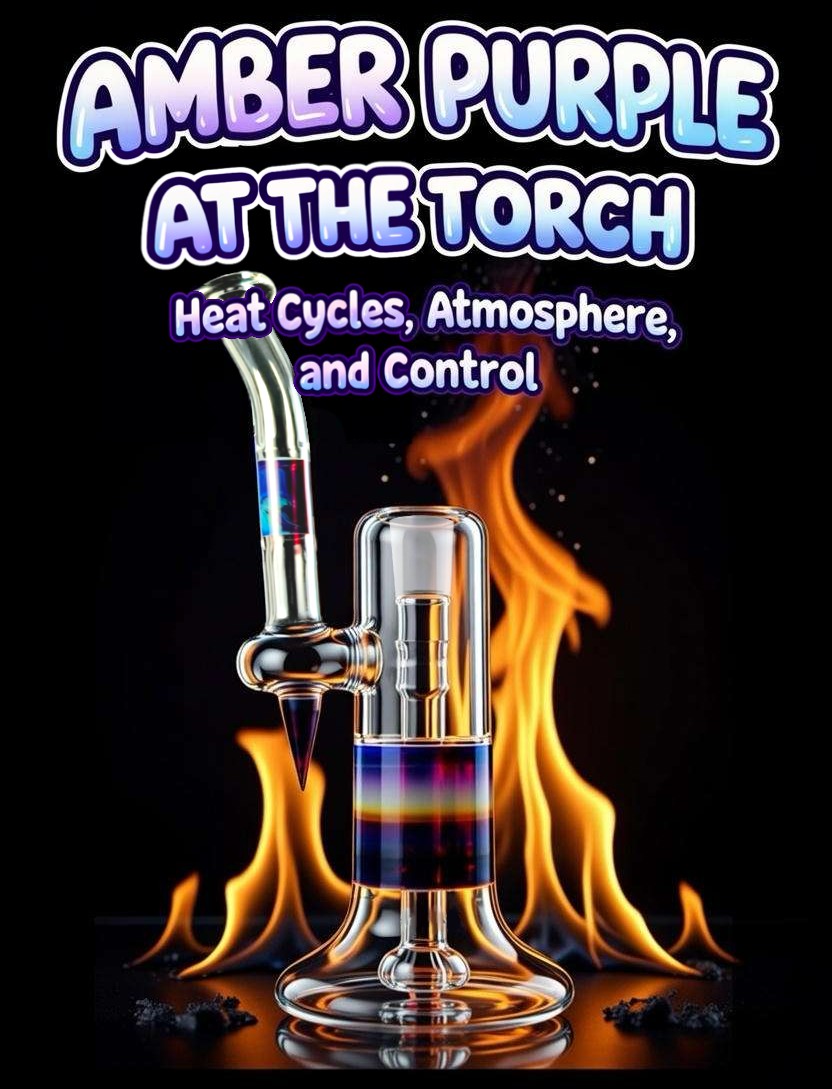
In the first post of this series, we talked about what Amber Purple is, where it comes from, and why it behaves differently than most colours. At the end of that post, we said the next step would be understanding how heat, flame atmosphere, and timing shape the final look of the glass. That is exactly what this post is about.

Amber Purple is not a colour you force into place. It is a colour that develops slowly through repeated heat cycles and careful control at the torch. When it works well, it feels almost effortless. When it goes wrong, it usually comes from improper flame settings and rotational speed.

Heat Cycles Are the Foundation

close up of amber purple mouth piece

Amber Purple is often called a striking colour, but that word alone does not fully explain what is happening. The colour develops through a series of heat and cool cycles, not a single moment at the torch. Early on, the glass may look pale, amber, or even close to clear. This is normal and not a sign that something has gone wrong.

The real colour begins to appear after the glass is heated evenly, allowed to cool until the glow fades, and then gently reheated. Each time this happens, the silver inside the glass shifts and reorganizes. These changes build on each other. Long, aggressive heating, tends to erase progress. While short, controlled reheating, allows the colour to deepen and separate.

Instead of chasing colour, it helps to think in terms of rhythm. Heat the glass evenly, let it rest, then bring it back slowly. Amber Purple responds best when it is given time to do the work itself.

Flame Atmosphere Shapes the Outcome

Flame chemistry plays a major role in how Amber Purple finishes, even when the heat cycles are done well. In a neutral to slightly oxidizing flame, the glass tends to stay clear and open. This environment supports cooler purples, lavenders, blues and softer transitions between colours.

A reducing flame changes the direction of the colour. Brief exposure can bring out warmer ambers, gold tones, and oil-like surface effects. Too much reduction, however, often leads to muddy browns or dull greys that are difficult to recover.

For most of the process, Amber Purple benefits from staying in neutral to slightly oxidizing flame environment. A reducing flame works best when it is applied lightly and late, almost as a final adjustment rather than a constant condition.

Timing Matters More Than Power

Many problems with Amber Purple come down to timing and flame settings. Reheating the glass too soon after the glow disappears can stall colour development. Letting it cool too far can make the next heat cycle uneven. Trying to force the colour by adding more heat usually makes things worse.

amber purple bubbler

One factor that often gets overlooked is rotational speed. Once the flame is set correctly, slowing down your rotation can make a noticeable difference. A slower turn allows the heat of the flame to penetrate deeper and faster into the glass instead of just skimming the surface. This helps burn off the initial, dull layer of silver and gives the colour room to develop beneath it.

When rotation is too fast, the surface stays hot while the interior never quite catches up. Slowing down creates an even heat profile and reduces the urge to overheat the outside and strengthen the initial layer of silver.

Learning when to pause, slow down, and let heat soak in is just as important as knowing when to reintroduce the flame.

Where You Place the Color Matters

Amber Purple behaves differently depending on where it sits in a piece. Thicker sections hold heat longer and tend to strike deeper and richer. Thinner areas cycle faster and are easier to overwork. When Amber Purple is placed next to clear, the surrounding mass can help stabilize heat and improve clarity.

Design choices matter here as much as flame control. Forms with clean lines and even wall thickness heat more evenly, which gives Amber Purple the time and stability it needs to develop fully. When the design works with the natural transparency of the colour instead of trying to overpower it, the result is clearer, deeper, and far more consistent.

Common Problems and What Causes Them

crucible pulled amber purple tubing in different stages of heat cycles

When Amber Purple turns muddy or brown, it is usually the result of too much reduction. A very common issue is a grey or dull finish caused by not fully burning off the initial silver haze. This happens when the surface stays hot but the heat never penetrates deeply enough to clear that first layer of silver.

Greying from this haze is often tied to moving too fast at the torch. High rotational speed can keep the surface active while the interior remains underheated. Slowing rotation and allowing the heat to soak in helps clear the haze before additional heat cycles are introduced.

Washed-out greys can also come from repeated reheats without enough cooling time in between. Patchy or uneven colour is commonly tied to uneven wall thickness or heating only part of a section instead of the whole area. Understanding these outcomes makes it easier to avoid or utilize them.

Consistency Comes From Process

Working Amber Purple successfully is less about tricks and more about repeatable habits. Paying attention to flame atmosphere, heat timing, and cooling intervals leads to more consistent results over time. Treating the colour as a system rather than a mystery helps remove frustration from the process. Small notes about what worked and what did not can go a long way toward dialing in control.

What Comes Next

In the next post, the focus will move away from the torch and into cooling and annealing. We will look at how kiln schedules affect Amber Purple, why some pieces look better the next day, and how post-flame decisions can either preserve or flatten the colour you worked to develop. What happens after the torch matters just as much as what happens in it.

This blog series includes insights informed by technical discussions and historical BoroNews newsletters published by Northstar Glassworks, a leading borosilicate glass manufacturer and pioneer of striking and transparent borosilicate colours used by artists worldwide. Northstar’s colour palette and working characteristics have played a foundational role in how artists understand flame reaction and colour development in borosilicate. For more archived newsletters and colour information, visit https://www.northstarglass.com.

All examples shown in this series feature Amber Purple borosilicate worked by Green Belt Glass.

Lorem Ipsum has been the industry’s standard dummy text ever since the 1500s.